
Best CNC Router for Hobbyists: Picks by Size and Budget
The best hobby CNC routers in October 2026, from a $269 Genmitsu 3018 to a $3,800 Shapeoko 5.1 Pro 4x4, compared by work area, drive type, spindle and price.
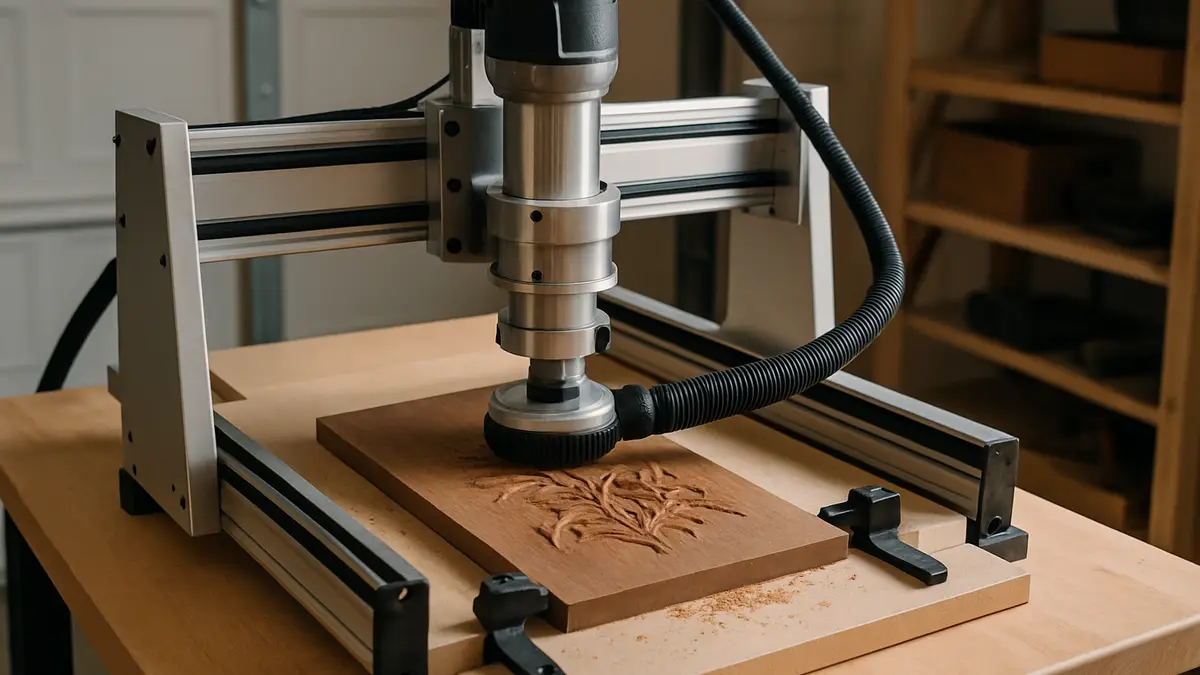
A hobby CNC router is a computer-controlled cutting machine that moves a spinning bit over a flat bed to carve, pocket and cut wood, plastic and soft metal. The best one for you is set by three numbers: the size of your projects, how rigid the frame and drive are, and what you can spend in total, not only on the machine.
We did not test these machines hands-on. We compared the makers’ US stores and spec sheets in October 2026 (SainSmart Genmitsu, Onefinity, Carbide 3D and Inventables) with owner-forum consensus, and we say what each machine cannot do.
Which CNC router should a hobbyist buy?
Buy for the largest project you will make often, then pick the stiffest drive you can afford at that size. The ladder below runs from a $269 starter to a $3,800 full-sheet machine.
| Machine | Work area | Drive (X/Y) | Spindle or router | US price, Oct 2026 | Best for |
|---|---|---|---|---|---|
| Genmitsu 3018-PROVer V2 | 290 x 180 x 40 mm | Lead screw, round shafts | 775 DC motor, 42 mm | $269 | Learning, PCBs, name plates |
| Genmitsu 4040 Reno | 400 x 400 x 76 mm | Belt (lead screw on Z) | 75 W DC, 9,000 rpm max | $449 | Light carving on a budget |
| Genmitsu 4040-PRO | 400 x 400 x 78 mm | Lead screw | DC spindle, 9,000 rpm max | $479 | Signs and boxes, upgradeable |
| Genmitsu 4040-PRO MAX | 400 x 400 x 78 mm | Lead screws, linear guide rail on Z | 710 W trim router, 6,500 to 30,000 rpm | $849 | Best value desktop machine |
| Onefinity Apprentice | 16.5 x 16.5 in (419 mm) | 16 mm ball screws, 30 mm shafts | Takes a 65 mm Makita RT0701C or spindle | $995 (sale; $1,199 list) | Rigid small machine with room to grow |
| Genmitsu PROVerXL 4030 V2 | 400 x 300 x 110 mm | Ball screws, closed-loop motors | Varies by bundle | $1,199 | Accuracy in a small footprint |
| Onefinity Gen 2 Elite | from 33 x 33 in (Woodworker) | 1616 ball screws, closed-loop | 65 or 80 mm mount | from $2,195 | Large signs, furniture parts |
| Genmitsu PROVerXL 2x2 | 679 x 679 x 113 mm | Ball screws, closed-loop | 710 W, 30,000 rpm, ER11 1/4 and 1/8 in collets | $2,599 | Garage shop, light metal |
| Shapeoko 5.1 Pro 2x2 | about 2 x 2 ft | 16 mm ball screws, HG-15 rails | Carbide Compact Router included | $2,980 | Rigid 2 x 2 with a large user base |
| Shapeoko 5.1 Pro 4x4 | about 4 x 4 ft | 16 mm ball screws, HG-15 rails | Carbide Compact Router included | $3,800 (legs +$350) | Full-width sheet work |
Prices are the lowest machine-only configuration on each maker’s US store in October 2026. Router, dust shoe and software are not always included: check the bundle.
Is a 3018 CNC good enough for woodworking projects?
No, not for most woodworking. A 3018 is an engraving, PCB and small-plaque machine. The Genmitsu 3018-PROVer V2 ($269, or $299 with an offline controller) cuts a 290 x 180 mm area with 40 mm of Z travel, rides on round shafts and lead screws, and uses a 775 DC motor with a 42 mm body.
That combination limits it to small bits, shallow passes and soft materials. A 12 x 18 in cutting board does not fit, and cutting 18 mm plywood parts means many slow passes. It is a fine $269 way to learn CAD, CAM and G-code. If you already know you want to make signs, start at the 4040 class.
Which is better under $500: the 4040 Reno or the 4040-PRO?
The 4040-PRO is the better buy at $479 if you will cut plywood and hardwood; the 4040 Reno ($449) is fine for light V-carving. Both cut a 400 x 400 mm area, about 15.7 x 15.7 in, which fits most signs, coasters and small boxes.
The difference is the drive. The Reno moves X and Y with belts and its spindle is a 75 W DC motor topping out at 9,000 rpm. The 4040-PRO uses lead screws on all axes, and its Z carriage takes 65 mm and 69 mm spindle mounts (sold separately), so you can fit a trim router later. Lead screws resist the push of a cutting bit better than belts, which matters on deeper passes.
Neither stock spindle is strong. Expect slow, shallow passes in hardwood until you upgrade.
Which is the best hobby CNC router under $1,000?
The Genmitsu 4040-PRO MAX ($849) and the Onefinity Apprentice ($995) are the two to compare. The PRO MAX ships with a 710 W trim router (6,500 to 30,000 rpm), a reinforced chassis and a linear guide rail on Z, in the same 400 x 400 mm footprint. It is a complete package with a real trim router for under $900.
The Onefinity Apprentice cuts 16.5 x 16.5 in on 16 mm ball screws and 30 mm hardened steel shafts with NEMA 23 motors, the same motion design as Onefinity’s larger machines. It is designed around the Makita RT0701C trim router or Onefinity’s 65 mm spindle, so check whether your bundle includes one. Choose the Apprentice for rigidity and an upgrade path; choose the PRO MAX for the lowest all-in price.
What is the best 2 x 2 ft CNC router for a garage shop?
A 2 x 2 ft machine is the point where hobby signs, cabinet doors and serving boards fit without tiling. Three machines lead, all ball-screw driven:
- Onefinity Gen 2 Elite Woodworker, from $2,195: 33 x 33 in cutting area, 1616 ball screws, closed-loop motors and a Z-20 slider with about 165 mm of travel. Router or spindle is a separate choice.
- Genmitsu PROVerXL 2x2, $2,599: 679 x 679 x 113 mm, closed-loop motors, and a 710 W 30,000 rpm spindle with both 1/4 in and 1/8 in ER11 collets.
- Shapeoko 5.1 Pro 2x2, $2,980 with the Carbide Compact Router: HG-15 linear rails on every axis and 16 mm ballscrews, with Carbide 3D’s Carbide Create software and a large, active owner forum.
Pick on software and support preference as much as specs; all three are far stiffer than any belt machine.
Which CNC router handles 4 x 4 ft sheet work?
The Shapeoko 5.1 Pro 4x4 ($3,800, legs $350 more) and the Onefinity Gen 2 Elite Foreman (49 x 49.125 in) are the hobby-priced full-sheet options. The Shapeoko 5.1 Pro 4x2 costs $3,550. Inventables’ X-Carve Pro 4x4 lists at $7,495 and sits closer to small-business territory.
A 4 x 4 machine needs a dedicated stand or table, a vacuum or dust collector sized for the gantry, and, by our rough planning figure, about 5 x 6 ft of floor once you allow walking room. Inventables has also announced it is sunsetting its belt-driven X-Carve kits.
Belt, lead screw or ball screw: does the drive really matter?
Yes. The drive sets how hard you can push a bit before the machine deflects, and that sets how fast you can cut.
| Drive | How it moves | Strength | Weakness | Examples |
|---|---|---|---|---|
| Belt | Toothed belt on pulleys | Cheap, fast travel | Stretches under load; lighter passes | 4040 Reno (X/Y), Shapeoko 4 |
| Lead screw | Threaded rod and nut | Stiffer than belts, low cost | Slower, some backlash | 3018-PROVer V2, 4040-PRO |
| Ball screw | Recirculating balls in a nut | Low backlash, high stiffness | Costs more | Onefinity, Shapeoko 5.1 Pro, PROVerXL |
For V-carved signs in pine, a belt machine is enough. For hardwood pockets, inlays and aluminum, ball screws repay the price. Our CNC router guide explains frames, spindles and Z travel in more detail.
What size work area do hobby projects need?
Most hobby projects fit inside 400 x 400 mm; signs and furniture parts push you to 2 x 2 ft or larger. Measure the projects you will make most often, then add 2 in each way for clamps.
| Project | Typical size | Smallest class that fits |
|---|---|---|
| Coasters, name tags, PCBs | 4 x 4 in | 3018 |
| Small signs, boxes, earrings | 8 x 12 in | 4040 |
| Cutting boards, serving trays | 12 x 18 in | 2 x 2 ft |
| House signs, cabinet doors | 12 x 30 in | 4 x 2 ft, or 2 x 2 ft with tiling |
| Plywood furniture parts | 24 x 48 in | 4 x 4 ft |
Tiling (cutting one long piece in sections) works on open-front machines like the Onefinity Apprentice, but it adds setup time and alignment risk.
What does the machine price leave out?
Almost every hobby CNC needs more than the box: bits, clamps or a spoilboard, a dust shoe and shop vacuum, software, and often the router itself. These add-ons commonly run to a few hundred dollars.
Start with a small bit set rather than a 40-piece kit; our CNC router bits guide lists a seven-bit starter set. Software ranges from free (Easel’s free tier, Carbide Create’s free tier, gSender) to paid VCarve; see the CNC router software comparison. The full budget, with three sample setups, is in our CNC machine cost breakdown.
Who should not buy a hobby CNC router?
Skip a hobby router if your main work is steel parts (a router cannot cut steel; look at a plasma table), small precise aluminum parts (a desktop CNC mill is stiffer), or engraving gifts and thin cutouts (a diode laser is faster, quieter and cleaner for that). Also skip it if you cannot control noise and dust: a trim router at full speed is loud, and MDF dust needs real extraction, not an open window.
How did we compare these CNC routers?
We took work area, drive, spindle and price from each maker’s US product page in October 2026: SainSmart (Genmitsu), Onefinity, Carbide 3D (Shapeoko) and Inventables. We did not run cutting tests. Where a maker describes a capability, such as cutting aluminum, we attribute it. For starting RPM and feed on any of these machines, use the CNC mode of our feeds and speeds calculator, then cut a test pocket in scrap.
Frequently asked questions
Quick answers to what readers ask us most
What is the best CNC machine for a beginner?
A 400 x 400 mm desktop router with a trim router spindle, such as the Genmitsu 4040-PRO MAX ($849) or Onefinity Apprentice ($995). Both are big enough for signs and boxes and small enough for a bench, and both take a standard 1/4 in bit collet.
Is a 3018 CNC good for woodworking?
Only for small engraving. The Genmitsu 3018-PROVer V2 cuts 290 x 180 mm with 40 mm of Z travel and a small DC spindle. It is a good learning, PCB and name-plate machine, but slow and too small for signs or furniture parts.
How much should a hobbyist spend on a CNC router?
Plan $450 to $1,000 for a capable desktop machine, or $2,200 to $4,000 for a rigid 2 x 2 ft to 4 x 4 ft machine. Add a few hundred dollars for bits, clamps and dust collection on top of the machine price.
Are belt-driven CNC routers accurate enough?
For wood signs and carving, yes, if the belts are tensioned. Belts stretch under heavy cuts, so belt machines take lighter passes than lead-screw or ball-screw machines. For aluminum or tight joinery, ball screws hold accuracy better.
Can a hobby CNC router cut aluminum?
Yes, slowly, on rigid machines. Genmitsu markets the 4040-PRO MAX and PROVerXL 2x2 for light metal work, and owners of ball-screw machines report cutting aluminum with single-flute bits and shallow passes. Steel is not a router job.