
Diode vs CO2 vs Fiber Laser: Which Type Fits Your Work
Diode, CO2 and fiber lasers compared by wavelength, what each engraves and cuts in 15 materials, running costs and October 2026 prices, with a pick rule.
Diode, CO2 and fiber lasers are three different light sources, and each wavelength is absorbed by a different set of materials. That one physical fact decides almost everything: what the machine can engrave, what it can cut, what it cannot touch at all, and how much it costs to run.
We did not test machines hands-on for this page. The wavelengths, lifetimes and prices come from manufacturer spec sheets and the makers’ US stores in October 2026 (Creality Falcon, xTool, OMTech, Monport), and the material matrix reflects manufacturer material libraries and well-documented absorption behavior.
What is the difference between diode, CO2 and fiber lasers?
The difference is wavelength. A blue diode laser emits visible light at about 445 to 455 nm (Creality specifies 455 nm, plus or minus 5 nm, for the Falcon A1 Pro). A CO2 laser emits far-infrared light at 10,600 nm from a gas-filled tube. A fiber laser emits near-infrared light at 1,064 nm from a doped optical fiber.
| Blue diode | CO2 | Fiber | |
|---|---|---|---|
| Wavelength | 445 to 455 nm | 10,600 nm | 1,064 nm |
| Beam delivery | Gantry, moving head | Gantry with mirrors | Galvo mirrors (most hobby units) |
| Best at | Wood, leather, slate, coated metal | Acrylic, wood, glass, leather | Bare metal, some plastics |
| Cuts | Thin wood, dark acrylic | Wood and acrylic, thicker sheets | Very thin metal foil only (hobby power) |
| Typical work area | About 270 to 500 mm wide | About 400 to 600 mm wide (desktop) | About 175 to 220 mm square field |
| US price, Oct 2026 | $300 to $1,700 | $1,149.99 to $4,999.99 desktop | $1,999.99 to $5,299 (units we checked) |
Price examples: Ortur Laser Master 3 10 W $299.99 and xTool S1 40 W $1,699 (diode); Monport Reno 45 W Basic (16 x 12 in) $1,149.99, OMTech Polar Lite 55 W $2,199.99, xTool P2S 55 W $2,999 and OMTech Polar 2 50 W RF $4,999.99 (CO2); OMTech MOPA 20 W split fiber $1,999.99 and xTool F2 Ultra 60 W MOPA plus 40 W diode $5,299 (fiber).
Which laser type works on which material?
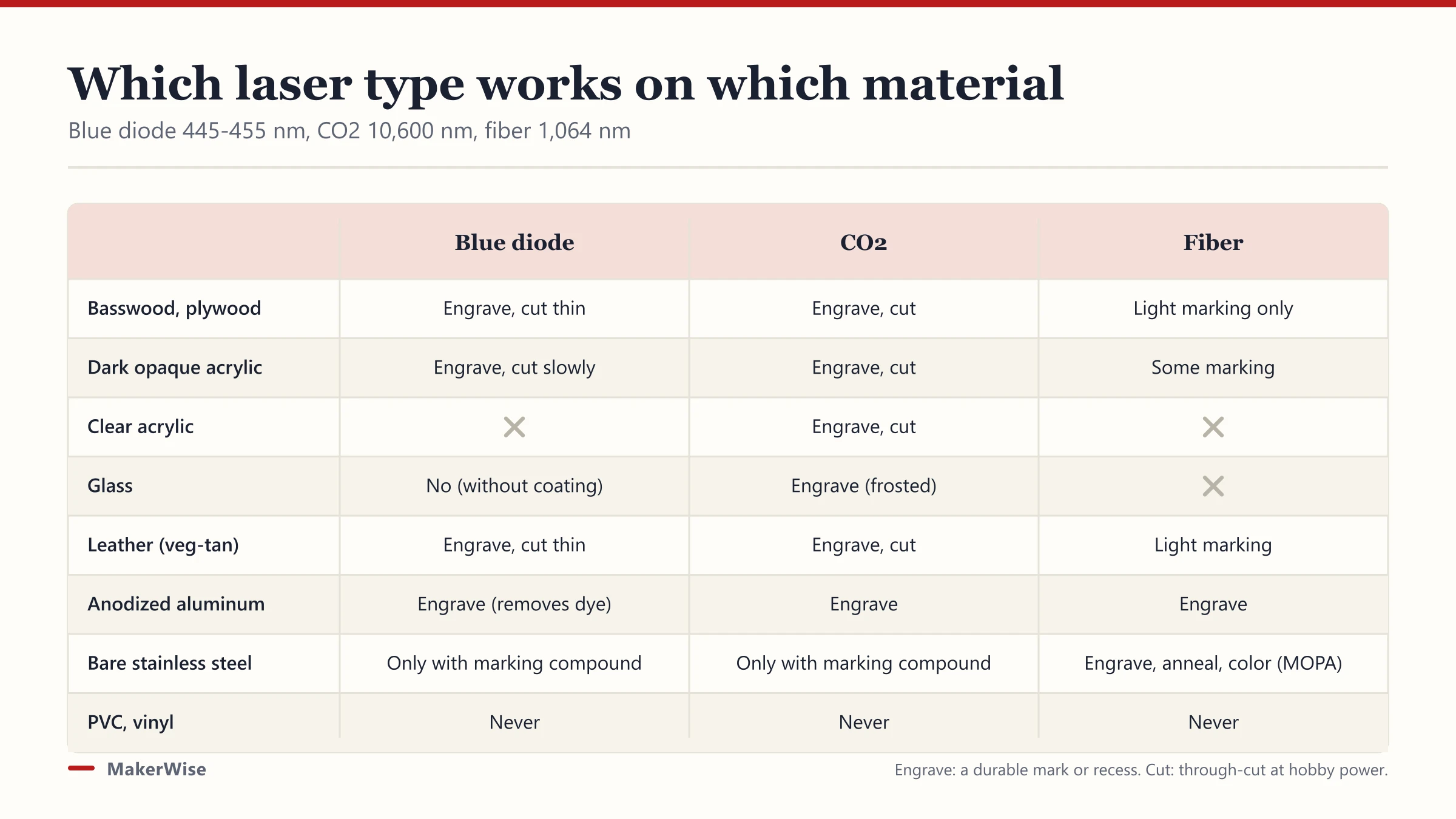
Use this matrix to rule a type in or out before comparing machines. “Engrave” means a visible, durable mark or recess; “cut” means through-cutting at hobby power in a sensible number of passes.
| Material | Blue diode | CO2 | Fiber | Why |
|---|---|---|---|---|
| Basswood, plywood | Engrave, cut thin | Engrave, cut | Light marking only | Wood absorbs 450 nm and 10,600 nm well; 1,064 nm far less |
| Hardwood (maple, walnut) | Engrave, cut thin slowly | Engrave, cut | Light marking only | Denser wood needs more energy per mm |
| MDF | Engrave, cut thin | Engrave, cut | Light marking only | Glue content chars edges on all types |
| Dark opaque acrylic | Engrave, cut slowly | Engrave, cut | Some marking | Dark pigment absorbs visible light |
| Clear acrylic | No | Engrave, cut | No | Clear acrylic transmits 450 nm and 1,064 nm but absorbs 10,600 nm |
| Glass | No (without coating) | Engrave (frosted) | No | Glass transmits visible and near-IR light |
| Leather (veg-tan) | Engrave, cut thin | Engrave, cut | Light marking | Organic material absorbs both diode and CO2 light |
| Paper, card | Engrave, cut | Engrave, cut | No | Burns easily; fiber passes most energy through |
| Slate, stone | Engrave | Engrave | Marks | Surface color change on all types |
| Anodized aluminum | Engrave (removes dye) | Engrave | Engrave | Anodized layer absorbs well; fiber can go deeper |
| Powder-coated steel | Removes coating | Removes coating | Removes coating, marks steel | Coating absorbs; bare steel only reacts to fiber |
| Bare stainless steel | No (only with marking compound) | No (only with marking compound) | Engrave, anneal, color (MOPA) | Metals reflect 450 nm and 10,600 nm; 1,064 nm couples into metal |
| Brass, copper, silver | No | No | Engrave; thin sheet cutting on some units | Same as stainless; copper reflects strongly |
| Fabric, felt | Engrave, cut (dark) | Engrave, cut | No | Natural fibers absorb CO2 light best |
| PVC, vinyl | Never | Never | Never | Releases chlorine compounds that damage lungs and the machine |
For wood specifics by power and species, see our laser engraver for wood guide. For metal routes in detail, see the laser engraver for metal guide.
When is a diode laser the right choice?
A diode laser is the right choice when your work is wood, leather, slate, cork, paper and coated metal, and your budget is under about $1,700. It is the cheapest way into lasering, and enclosed Class 1 diodes such as the Creality Falcon A1 Pro (20 W, from $1,099) and xTool S1 can run in a spare room with a vent.
Diodes have two hard limits: they cannot work clear materials, and they cut slower than a CO2 of similar price. A 40 W diode such as the xTool S1 40 W ($1,699) narrows the cutting gap on plywood, but it still cannot cut clear acrylic. Our best laser engraver for beginners compares eight diode and entry CO2 machines.
When is a CO2 laser worth the extra cost?
A CO2 laser is worth it if acrylic, glass or fast cutting is central to your work. Its 10,600 nm beam is absorbed by acrylic of any color, glass, wood, leather, fabric and rubber. xTool rates its 55 W P2S for one-pass cuts through 18 mm basswood and 20 mm clear acrylic, a thickness no hobby diode approaches.
Desktop CO2 prices in October 2026 start at $1,149.99 for the Monport Reno 45 W Basic (16 x 12 in bed); the OMTech Polar Lite 55 W costs $2,199.99. The xTool P2S 55 W ($2,999) adds dual 16 MP cameras, autofocus and a 600 x 305 mm bed, and is sold in both Class 4 and Class 1 versions. CO2 machines also need more space and care: most glass-tube machines need water cooling, and the tube is a consumable. Our best CO2 laser cutter picks compare desktop machines by bed size, tube type and budget.
A CO2 laser is not a metal tool. It strips anodizing and powder coat, and with a marking compound it can leave a black mark on stainless, but it does not engrave bare metal.
What is a fiber laser and who needs one?
A fiber laser is a solid-state laser whose 1,064 nm beam is created inside a doped glass fiber, and hobby units steer it with fast galvo mirrors over a small field. That wavelength is absorbed by metals, so fiber lasers engrave stainless steel, brass, aluminum, titanium, silver and gold directly, with no coating.
You need one if you mark tools, jewelry, knives, firearm parts, tags or metal business cards. You do not need one for wood signs: fiber energy is poorly absorbed by wood and passes through clear plastics. Hobby fiber prices run from $1,999.99 (OMTech MOPA 20 W split) to $2,199.99 (OMTech Galvo 30 W split, 6.9 x 6.9 in field) and $2,999 (xTool F1 Ultra, 20 W fiber plus 20 W diode).
A MOPA fiber laser lets you adjust pulse length, which makes color marking on stainless and darker marks on anodized aluminum possible. Standard (Q-switched) fiber lasers mark well but with less control over color.
Do you need two laser types?
Many makers end up with two, because no single wavelength covers wood, clear acrylic and bare metal. Dual-laser machines are the compromise:
- Creality Falcon A1 Pro with the optional 2 W infrared (1,064 nm) module: diode for wood, IR for light metal marking.
- xTool S1 with its 1,064 nm IR module ($599), or the S1 plus IR bundles from $1,949.
- xTool F1 Ultra ($2,999): 20 W fiber plus 20 W diode in one galvo machine.
- OMTech Solis Duo 30 W fiber plus 20 W diode ($3,099.99) and Monport Autoforge XPro 30 W fiber plus 20 W diode ($3,499.99).
A low-power IR module marks metal slowly and shallowly; it does not replace a true fiber source for deep engraving. None of these dual machines cuts clear acrylic, which still needs CO2.
What does each laser type cost to run?
Running cost is mostly the light source wearing out, plus electricity, air assist and fume filters. Manufacturer lifetimes differ by an order of magnitude.
| Source | Maker-stated lifetime | Replacement example (Oct 2026) |
|---|---|---|
| Glass CO2 tube | Roughly 1,500 to 4,000 hours in hobby systems (OMTech) | OMTech 55 W tube $319.99; xTool P3 80 W tube $402.90 |
| RF metal CO2 tube | More than 30,000 hours (OMTech) | Usually a factory repair, not a user swap |
| Fiber source | Up to 100,000 hours (OMTech) | Rarely replaced in hobby use |
| Blue diode module | Not consistently published | xTool S1 20 W module $513; Creality A1C 10 W module $139 |
Fume filters are the other recurring cost if you use a purifier instead of venting outdoors. As one price reference, Monport sells the replacement filter cartridge set for its 600W fume extractor at $600.
Which laser type is safest at home?
An enclosed Class 1 machine of any type is the safest choice, because the enclosure blocks the beam during normal use. Open-frame diodes and open galvo fiber units are Class 4 and need eyewear rated for their exact wavelength. Glasses for 450 nm do not protect at 1,064 nm or 10,600 nm unless the label lists those wavelengths too, and OMTech recommends OD5 or higher for open-bed use.
Fiber light at 1,064 nm is invisible, so you get no visual warning of a stray reflection. Our laser engraver safety guide covers eyewear labels, fume extraction and fire watch.
How do you choose between diode, CO2 and fiber?
Start from the three materials you will use most, then apply these rules:
- Mostly wood, leather, slate and coated tumblers, budget under $1,700: diode, enclosed if indoors.
- Any clear acrylic, glass, or lots of cutting: CO2, from about $1,150.
- Bare metal marking is the main job: fiber, about $2,000 and up for the established brands we checked.
- Wood plus occasional light metal marks: a diode with a 1,064 nm IR module.
- Metal plus wood engraving in one small-field machine: a fiber plus diode galvo.
Once you have chosen, our laser settings calculator gives starting power and speed for each type. Software follows the choice: diode machines run on LightBurn Core, LaserGRBL or the maker’s app, while galvo and Ruida-controlled CO2 machines need LightBurn Pro or the maker’s software. See our laser engraving software comparison.
Who is this comparison not for?
This page is for hobby and small-shop machines up to about $5,000. It does not cover industrial fiber cutters of 1 kW and above, which cut sheet metal and sell for tens of thousands of dollars (OMTech’s FC-24 3,000 W cutter lists at $43,999), nor medical or cosmetic lasers, which share the “diode” and “CO2” names but are unrelated products. It also leaves out handheld fiber welders and rust-cleaning lasers, which have their own guides: handheld laser welder and laser cleaning machine.
Frequently asked questions
Quick answers to what readers ask us most
Is a fiber laser better than a CO2 laser?
Only for metal. A fiber laser's 1,064 nm beam marks bare steel, brass and aluminum quickly, while a CO2 laser's 10,600 nm beam is far better on wood, acrylic, glass and leather. Many shops that do both own one of each or a dual-laser machine.
Can a diode laser do what a CO2 laser does?
On wood, leather and dark opaque acrylic, a 20 W or 40 W diode gets close at a lower price, but more slowly. It cannot engrave or cut clear acrylic or clear glass, which a CO2 laser handles easily.
Can a CO2 laser engrave metal?
Not bare metal on its own. A CO2 laser removes coatings such as anodizing and powder coat, and it can fuse a marking compound onto stainless steel. For direct engraving into bare metal you need a fiber or 1,064 nm infrared laser.
Which laser type lasts the longest?
Fiber sources. OMTech quotes up to 100,000 hours for fiber lasers, more than 30,000 hours for RF metal CO2 tubes, and roughly 1,500 to 4,000 hours for hobby glass CO2 tubes, which are a recurring cost.
What is a MOPA fiber laser?
A fiber laser whose pulse length can be adjusted. That control lets it produce colors on stainless steel and darker marks on anodized aluminum. A standard Q-switched fiber laser marks metal well but with less color control.