
Laser Engraver for Metal: Fiber, IR, or Diode with Spray
The four ways to laser engrave metal at home in October 2026: fiber galvo, 1,064 nm IR module, CO2 or diode with marking compound, and coated metal only.
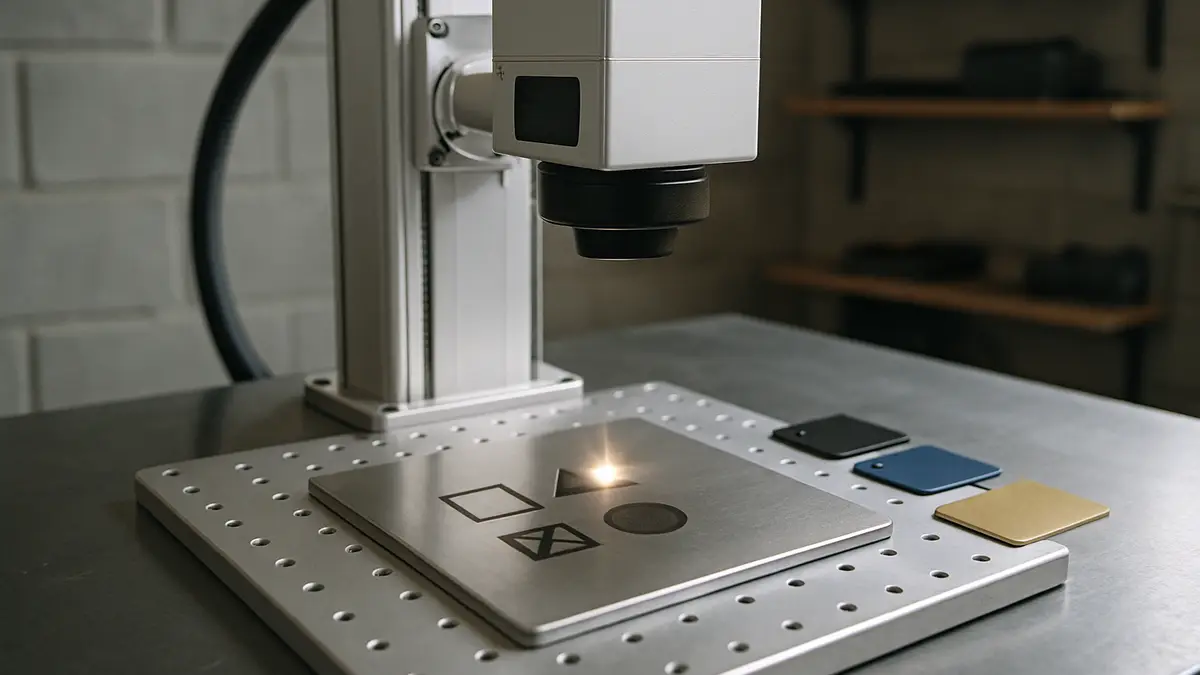
A laser engraver for metal is a laser whose light the metal actually absorbs, which in practice means a 1,064 nm fiber or infrared source. Blue diode and CO2 lasers are sold as “metal engravers” too, but they work on coatings or on a marking compound, not on the bare metal itself.
This page compares the four routes by what they do to the surface, what they cost in October 2026 and how deep they go. We did not run hands-on tests; specs and prices come from the makers’ US stores (OMTech, xTool, Creality Falcon, Monport, Ortur) and their published material guidance.
Which laser can engrave metal?
Only lasers at about 1,064 nm engrave bare metal directly. Metals reflect most blue (450 nm) and CO2 (10,600 nm) light, so those types work only on coatings or with a compound.
| Route | What it does to metal | Typical cost, Oct 2026 | Best for | Limits |
|---|---|---|---|---|
| Fiber galvo laser (1,064 nm, 20 to 60 W) | Engraves, marks, anneals; MOPA adds color on stainless | $1,999.99 to $5,299 | Serial numbers, jewelry, tools, tags, knives | Small field; weak on wood and clear plastics |
| 1,064 nm IR module on a gantry (1.2 to 5 W) | Light surface marks on bare metal | $299 to $599 as an add-on (Ortur, xTool); $1,299 for the xTool F2 | Occasional name tags and pet tags | Slow; shallow; not deep engraving |
| CO2 or diode plus marking compound | Bonds a dark ceramic-like layer to the surface | Compound plus your existing laser | Black marks on stainless with no new machine | Prep and cleanup; no depth |
| Blue diode or CO2 on coated metal | Removes anodizing, paint or powder coat | Your existing laser | Tumblers, anodized cards, painted signs | Bare metal underneath is unchanged |
If metal is a sideline to wood work, an IR module or compound is enough. If metal is the business, buy fiber. Non-laser marking machines, such as diamond drag and dot peen, are compared in our engraving machine types guide.
What is the difference between engraving, marking, etching and annealing?
The terms describe how much metal the laser moves. Engraving removes material and leaves a recess you can feel. Etching melts a very thin surface layer so it rises or roughens slightly. Marking is any visible change, including discoloration or bonded compound. Annealing heats stainless steel or titanium below melting so an oxide layer forms, leaving a smooth black or colored mark with essentially no material removed.
OMTech’s metal guidance notes that annealing removes minimal material and suits parts where the surface must stay intact, while softer metals such as gold and silver often look better annealed than engraved. When a listing says a diode “engraves metal”, it nearly always means marking a coating.
Is a fiber laser worth it for metal engraving?
Yes, if you mark metal weekly or sell metal items: a fiber laser engraves bare steel, brass, aluminum and titanium directly and fast, with no prep. These are the hobby and small-shop fiber units we checked in October 2026:
| Machine | Source | Field or work area | US price, Oct 2026 |
|---|---|---|---|
| OMTech MOPA 20 W split fiber | 20 W MOPA | 6.9 x 6.9 in | $1,999.99 |
| OMTech Galvo 30 W split fiber | 30 W Q-switched | 6.9 x 6.9 in | $2,199.99 |
| xTool F1 Ultra | 20 W fiber plus 20 W diode | 220 x 220 mm | $2,999 |
| OMTech Solis Duo | 30 W fiber plus 20 W diode | check spec sheet | $3,099.99 |
| Monport Autoforge XPro | 30 W fiber plus 20 W diode | check spec sheet | $3,499.99 |
| OMTech MOPA 60 W autofocus | 60 W MOPA | check spec sheet | $3,599.99 |
| xTool F2 Ultra | 60 W MOPA plus 40 W diode | check spec sheet | $5,299 ($4,299 MOPA only) |
Split units (separate laser source and head) are open machines and are Class 4, so they need an enclosure or rated eyewear. Fiber sources last: OMTech quotes up to 100,000 hours.
What is a MOPA fiber laser and do you need one?
A MOPA fiber laser is a fiber laser with adjustable pulse duration. That extra control lets it produce color marks on stainless steel, darker black marks on anodized aluminum and cleaner marks on some plastics. xTool markets color engraving as a feature of its 60 W MOPA F2 Ultra.
You do not need MOPA for serial numbers, logos on tools, dog tags or brass plaques; a standard Q-switched 20 to 30 W source does those well and costs less. Choose MOPA if color on stainless, black on anodized aluminum or sensitive plastics are part of what you sell.
Can a 1,064 nm infrared module mark metal on a diode machine?
Yes, lightly. Several diode makers sell 1,064 nm infrared modules that swap onto their gantry machines, and they mark bare metal and some plastics that blue light cannot touch. Examples in October 2026:
- xTool S1 1,064 nm IR module, 2 W: $599 as an add-on, or S1 plus IR bundles from $1,949.
- Creality Falcon A1 Pro, optional 2 W IR (1,064 nm, solid-state): Creality lists gold, silver, brass, iron, aluminum, stainless steel and titanium alloy.
- Ortur 1.3 W IR module (1,064 nm): $299.
- Creality A1C 1.2 W IR module for the budget A1C machine.
- xTool F2 portable: 5 W IR plus 15 W diode, $1,299.
At 1.2 to 5 W, these modules make surface marks slowly. They are not a substitute for a 20 W+ fiber source when you need depth, speed or production volume.
Can a diode or CO2 laser engrave metal with marking spray?
It can mark it. A marking compound such as LaserBond 100 is sprayed or brushed onto clean metal, dried, then lasered: the beam fuses the compound to the surface, and the unexposed compound washes off, leaving a dark, durable mark. LaserBond lists stainless steel, aluminum, brass and copper among its recommended metal surfaces, plus glass, ceramic and stone.
OMTech’s CO2 metal-engraving guide describes the same steps: degrease, apply a thin even layer, dry fully, laser, then clean. The result is a bonded mark with no depth, so it suits signs, plaques and tumblers with bare steel, not serial numbers that must survive wear. Check the compound’s label for your laser type and power.
Which metals are easiest to laser engrave?
Coated and anodized metals are the easiest, and bare stainless steel is the easiest bare metal. In rough order of difficulty for a hobby user:
- Anodized aluminum: every laser type can remove the dyed layer and reveal bright metal. Business cards and dog tags start here.
- Powder-coated steel (tumblers, bottles): diode, CO2 and fiber all remove the coating. See our tumbler engraving guide for rotary setups.
- Stainless steel: fiber engraves and anneals it; IR modules mark it; diode and CO2 need compound.
- Brass: fiber engraves cleanly; IR modules mark it lightly.
- Bare aluminum and copper: highly reflective; fiber works, but marks are lighter and need more passes.
For starting power and speed on anodized aluminum, powder coat and stainless, use the laser mode of our laser settings calculator.
How deep can a hobby laser engrave metal?
Hobby lasers engrave metal in thin layers, so depth is a matter of passes and time. OMTech lists about 0.1 mm per pass for its 60 W MOPA fiber; 20 and 30 W sources remove less per pass. A raised or recessed logo 0.3 to 0.5 mm deep means many passes and a hot part, so let it cool before handling.
IR modules of 1.2 to 5 W and marking compounds produce essentially surface-level marks. If you need a mark you can feel with a fingernail, plan on fiber.
Can a hobby laser cut metal?
Only very thin sheet. xTool states that the 20 W fiber in the F1 Ultra cuts up to 0.4 mm brass, 0.3 mm stainless steel and 0.2 mm aluminum, and that the 60 W MOPA F2 Ultra cuts up to 2 mm of brass, stainless or aluminum. The F2 and F2 Ultra UV do not cut metal at all; our UV laser engraver guide explains what 355 nm UV machines are for instead.
That is jewelry and inlay territory. For brackets, signs and parts from 1 to 6 mm steel, a CNC plasma table costs less and cuts much faster. Kilowatt fiber cutters exist, but they are industrial machines with industrial prices.
Can you laser engrave firearm parts at home?
You can mark parts you own, but the legal rules are the owner’s responsibility, and we do not give legal advice. For context, the federal regulation that applies to licensed manufacturers and importers, 27 CFR 478.92, requires serial numbers to be marked to a minimum depth of 0.003 in and in print no smaller than 1/16 in.
That depth is within reach of a fiber laser with multiple passes, and generally not of an IR module or a marking compound. Check the ATF’s current guidance and any state rules before marking a firearm.
How do you stay safe when engraving metal with a laser?
Fiber and IR light at 1,064 nm is invisible, and metal surfaces reflect it, so open units need eyewear rated for 1,064 nm at OD5 or higher; Monport, for example, sells 1,064 nm OD7 glasses for $45. Blue-diode glasses do not protect at 1,064 nm unless the label lists it. Coatings and compounds release fumes when lasered, so vent or filter as you would for wood.
Metal also heats up during deep passes, and coated tumblers can trap heat. Our laser engraver safety guide covers eyewear labels, laser classes and fumes.
Who is this guide not for?
This guide is not for anyone who needs to cut sheet metal parts thicker than about 2 mm: that is a plasma table job. It is also not for shops buying industrial fiber cutters, and not for people who only engrave wood and coated tumblers, where an ordinary diode laser is enough. Stripping rust and paint from metal is a different job again; see our laser cleaning machine guide. Start with our diode vs CO2 vs fiber comparison if you are still choosing a laser type, or our beginner laser picks if metal is a sideline.
Frequently asked questions
Quick answers to what readers ask us most
Can a diode laser engrave metal?
A blue diode cannot engrave bare metal; metals reflect its 450 nm light. It can remove anodizing, paint and powder coat, and it can fuse a marking compound onto stainless steel. For bare metal, add a 1,064 nm infrared module or use a fiber laser.
What is the cheapest way to laser engrave stainless steel?
A diode or CO2 laser you already own plus a marking compound such as LaserBond 100. The compound bonds a black mark to the steel. It adds a coating step and does not cut into the metal, so it is not a deep engraving.
How deep can a fiber laser engrave?
Depth builds up pass by pass. OMTech lists about 0.1 mm per pass for its 60 W MOPA fiber; lower-power fibers remove less per pass. Deep engraving of 0.5 mm or more takes many passes and time.
Can a hobby laser cut metal?
Only thin sheet. xTool rates the 20 W fiber in the F1 Ultra for 0.4 mm brass, 0.3 mm stainless and 0.2 mm aluminum, and the 60 W MOPA F2 Ultra for 2 mm. For cutting real steel plate at home, a CNC plasma table is the tool.
Do I need special glasses for a fiber laser?
Yes, for any open fiber unit. The 1,064 nm beam is invisible, so you get no warning of a reflection. Wear glasses labelled for 1,064 nm at OD5 or higher; glasses for 450 nm diodes do not protect at 1,064 nm unless the label lists both.